How AI Fries Your Brain. What High Performers Do About It.
Mar 12, 2026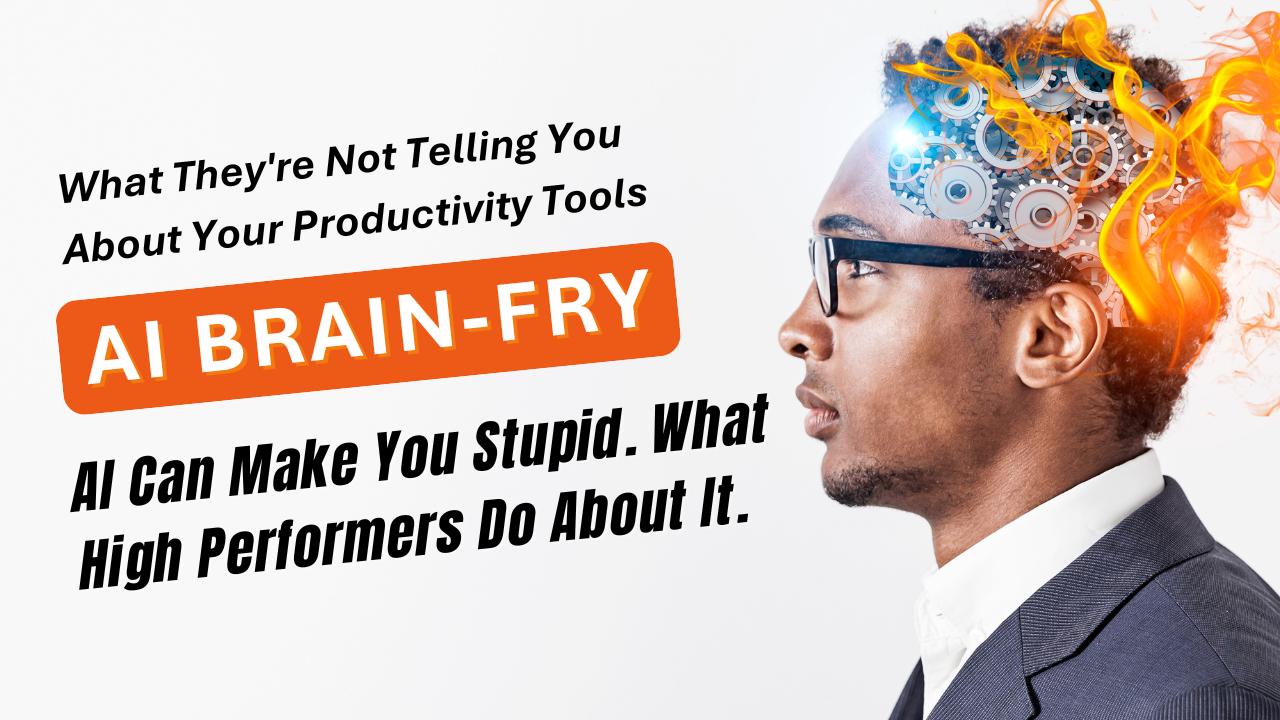
What if the tool that's supposed to save you time is actually hurting your ability to think for yourself? Experts always tell you to automate as much as possible to stay ahead in today's world of AI. But what if that's actually the thing that's holding you back? What if we're giving AI too much control over our critical thinking because it makes us faster?
Many believe that to succeed, companies must automate everything. Tools like ChatGPT, Claude, and Gemini can help with this. That's what everyone is saying.
AI Adoption Is Inevitable. Blind Conformity Is Not.
AI's been around for decades. It’s interesting to see how it evolved. The Turing test started in 1950, and by 1956, the term "artificial intelligence" was coined. Then there was ELIZA in the 60s, Deep Blue beating Kasparov in 1997, Siri in 2011, and ChatGPT launching in 2022. The tech is here, and it's advancing fast.
But relying on AI to replace human judgment leads to poor decision-making. It's like following the crowd without thinking about the consequences. In business, that's a major risk that can backfire.
What really sets a company apart these days isn't about using the most AI. It's about holding on to what makes you unique - your original thinking.
What AI Can Do. What It Cannot.
AI can definitely do certain things really well. It’s great at analyzing big data. It summarizes long documents. It also finds hidden patterns. But it can't hold itself accountable for its actions.
Basically, AI is like a super advanced version of autocomplete. It predicts what's most likely to come next based on what it's learned. It doesn't have any personal stake in the outcome. It cannot make accurate judgments about anything.
When companies want employees to fill in the gaps, issues arise. They rely on the machine's guess and expect accountability. That's when things begin to break down. Those employees get burnt out.
The Data on How They're Breaking.
A recent study by BCG and UC Riverside looked at about 1,500 full-time U.S. workers. It found that 14% are dealing with what’s called AI brain fry. This condition is mental fatigue. It comes from overusing AI tools. You may feel overwhelmed when trying to manage them beyond your brain's capacity.
It’s not the struggling workers facing the toughest challenges. It’s the high performers who are actually getting hit the hardest. People in tough jobs like marketing, software development, HR, finance, and IT really feel the pressure. That's because their job is all about being smart and making tough calls. When you give them AI results that are mostly correct but contain some errors, they don't ignore the mistakes. They spend a lot of time fixing them and double-checking, which can be really exhausting.
Workers experiencing AI brain fry are reporting some pretty specific symptoms. They mention feeling a constant buzz, being mentally foggy, and having bad headaches. Also, they take much longer to make decisions. It's like their brains are wearing down from the tools that are supposed to be making their lives easier.
The Real Cost Is Not What You Think.
That competitor you're worried about? They're not coming out on top. They're actually hurting their own finances.
It's not the work itself that's the problem. A study found that the most exhausting part of using AI isn't processing data - it's keeping an eye on everything. You have to supervise many AI tools at once, and that takes a toll. In fact, the more oversight required, the more mental fatigue people experience - a 12% increase, to be exact.
The financial impact is real. Workers who felt overwhelmed by AI experienced a 33% increase in decision fatigue. This causes bad decisions. It makes tough choices hard. Top performers also struggle to act.
It gets worse. Research shows that AI burnout increases employees' likelihood of quitting by 10%.
Your competitor isn’t winning. They’re burning out their top talent. This costs them in decision-making and kills their innovation. They're trading long-term success for short-term, mediocre results.
A senior manager in the study said it felt cluttered. It was like having too many browser tabs open in your head, all fighting for attention. It's not that people can't think straight; it's noisy, like mental static.
We've all been there - our laptops are slowing down because too much is running in the background. We're doing the same thing to our brains.
The manager realized they spent more time managing the tool than doing the real work. That's where AI hits a wall: when humans need to exercise judgment, it creates a major bottleneck.
Your Cognitive Muscles Are Atrophying.
This mental exhaustion doesn't end when you shut your laptop. Avi Loeb, a Harvard astronomy professor, raised concerns about a troubling trend. He believes people are losing their cognitive skills. This decline stems from the overuse of platforms like ChatGPT, Claude, and Gemini.
Loeb's comparison is spot on. He says it's like losing muscle mass when you take the bus instead of walking. If you ride the bus every day for a year, your legs will get weaker. It's the same with your brain - if you don't use it, you'll lose it.
If you depend too much on machines for thinking, your thinking skills can get rusty. Making an argument, looking at different views, and reaching a conclusion keeps your judgment sharp.
This isn't Loeb's opinion. A Swiss study found a strong link between frequent AI use and a decline in critical thinking skills.
The more you let the machine think, the worse you get at thinking.
Loeb notes that in academia, the best way to test students' thinking skills is to use a Faraday cage. This is a room that blocks all digital signals and internet access. It's pretty alarming, to be honest.
If employees rely too much on a language model for decisions, they may lose their critical thinking skills. That's a big problem for your company, because it's losing its cutting edge. It's being completely hollowed out from the inside.
When AI Replaces Human Judgment Entirely.
This issue doesn't stop at the office. In China, there's been a big jump in young women opting for AI chatbots over real partners. The government has warned tech firms against making AI that replaces human interaction. They are also developing new laws.
This is what happens when you take away the challenges and consequences. An AI chatbot can keep simulating conversations without ever asking for anything back. It's always validating and agreeing, never disagreeing. But it's really hurting our ability to deal with real people who are complicated and demanding.
Think about how this plays out in a professional setting. AI can't look a client in the eye and tell them they're making a mistake. It can't help someone have a tough but necessary realization. At its heart, business is about dealing with consequences. AI doesn't have that.
The Framework: Where the Machine Stops.
The real anxiety arises when you automate everything without careful thought. Your top performers must check many agents simultaneously. This causes mental overload, increases cognitive overload, and wears out your key people. On the other hand, if you ignore AI, you can't handle the amount of data needed to stay competitive, and you'll fall behind.
To move forward, you need to make AI a top priority, but with clear limits. Start by seeing the "AI can do everything" idea as a major business risk. Be clear about roles - AI processes data, and that's it. It takes chaotic data, summarizes it, and finds patterns that humans can't. That's what it's good at.
You're the one who makes the tough decisions. When you try to control AI's every move, it can be too much. Switching tools and double-checking everything adds to the stress. You’ll lose what really matters for a successful firm. That includes thinking for yourself, holding people accountable, and making key decisions.
What To Do Right Now.
This needs a deliberate choice. You can't just sit back.
Take a look at how you're working today. Be honest with yourself. Are you using AI to make sense of data and handle the tough stuff? Or are you burning out trying to compensate for its shortcomings? Do you have so many automated tools going that you feel like you've got a million things on your mind?
Spare 15 minutes to review what's on your plate right now. Pick one AI tool that's driving you crazy - the one that's got you managing instead of freeing up time. Shut it down - close that mental tab. Make the final call on that task yourself, using your own judgment.
Just pick one.
The Question Worth Sitting With.
If the world is losing critical thinking, your competitors depend on algorithms... What will happen in five or ten years? Think about it.
The most sought-after job title in business will be the human overseer. This person's main qualification is that they are not a machine - they know how to make a choice.
Protecting your ability to think for yourself is crucial. Over time, this skill grows more valuable. It sets you apart and boosts your success.
Protect that ability. It's the only one that compounds.
About Andrew Lawless
Andrew Lawless is a consultant, coach, and co-host of Build an AI. He works with CEOs and owners of U.S. professional services firms with 30 to 100 employees. His focus is a problem most firms won’t name out loud: founder judgment is carrying too many decisions, delivery quality changes based on who is in the room, and when a board or regulator asks for proof, the firm cannot produce it fast.
That gap traps firms between growth and exposure. Andrew’s work closes it. He helps owners set decision rules with clear inputs and approval steps, write standards that hold quality steady across teams, and introduce AI with written guardrails and traceable outputs. The goal is a firm that operates with calm control, clean proof, and predictable delivery.
His core argument: AI should amplify your judgment, not replace it. The firms that automate their thinking become commodities. The ones that use AI to process data and reserve original intelligence for the calls that matter: those are the ones that compound.
Over two decades of consulting, Andrew has advised Fortune 500 companies, government institutions, and elite teams, including the FBI, Special Forces, and the U.S. Senate, where he gave expert testimony on professional development and economic security.